Easy ways to keep your pool clean

iStock-610013900

If you are lucky enough to live in the Valley of the Sun and own a swimming pool, here are some pool maintenance tips for keeping your pool sparkling clean, inviting, refreshing and ready for use every day. The key is just staying on top of it. This will save you from making mistakes that could cost you a great deal of money. Routine pool maintenance may also prevent frustration and will minimize the need to make emergency runs to the pool store for chemicals or other additives.

Tips For Keeping Your Home Swimming Pool Sparkling Clean and Healthy To Use

  1. Check pool chemistry 2-3 times per week during the summer and once per week in the winter.
  2. Clean out skimmer basket(s) weekly, or as needed if conditions exist.
  3. Clean hair and lint pot in the pump every couple of weeks or as needed. Turn off pump to do this.
  4. Check and monitor water level at least once per month, adjust as needed. Water level should be at the center of the tile or skimmer.
  5. Check Deck-Chlor/Inline Chlorinator at least once per week for proper adjustment.
  6. Clean your filters. This may be necessary after a heavy storm or once every few months depending on conditions in your pool. It would be best to clean them about every 4-6 months. Just remind yourself to do it each time you come back from the dentist, or each time you change the air filters in your home, which should be about the same frequency. If you have an extra set of elements it is a much easier and quicker job. Soak dirty filters in a 10% solution of muriatic acid or a solution of TSP (trisodium phosphate). Use a rubber trash can. Wear gloves and eye protection. Be careful! Always add acid to water, NOT water to acid. Rinse until clean and let them dry. Put your supplies away until your next swap-out.
  7. As you are monitoring your pool, take note:

      – Are your returns very weak?

– Is the in-floor cleaning system not working very well?

– Is the water clarity starting to look bad?

If any of these conditions exist, it is likely time to clean the filters. Most pools should only need this done a couple of times a year. There are exceptions though based on bather load (pool usage).

  1. Wipe/clean tile line weekly. This will reduce build-up.
  2. If you have a salt water chlorine generator than you will need to check and clean the blades in the unit about every 30 days. If the red flow light or flow meter is on or reading less than normal, then the blades are likely calcified and producing little to zero chlorine. Turn the pump off, bleed off any pressure, undo the unions and clean the blades per the manufacturer’s recommendations.

10  Always keep chemicals stored out of direct sunlight. Keep them in a cool dry place. Do NOT store acid and chlorine right next to each other.

  1. Your pool should not need to be shocked on any regular basis if you have an ozone system. If you need to do it, do it at night. Use non-chorine based shock if you plan on swimming any time soon. Another way to shock your pool would be to run your pump for 24 hours using your ozone system. This works great! If you are on 24 hour circulation (2-speed or variable speed pump) than you should be just fine.
  2. If you start seeing any cracks around the perimeter of your pool between your deck and your tile, caulk it with a small bead of clear silicon. Do not allow the water to migrate from inside the pool in and under the deck through cracks at this joint.
  3. Keep vegetation, animals, chemicals (like fertilizers and ironite) away from and out of the pool. Nitrates from bird droppings and waste from animals and people are food for algae. Don’t feed the algae! 

Optimal Swimming Pool Chemical Ranges

Keep your pool’s chemical readings in these ranges:

PH: 7.2 to 7.8

Alkalinity: 80 to 120 ppm

Calcium Hardness: 250-450 ppm

Chorine residual: 1.0 to 1.5 ppm; upt to 2.0 in the summer with ozone, 3.0 without

Adjust down PH with muriatic acid. Never add more than a pint at a time. Re-test than add again as needed. As you add acid to adjust down the PH this should in turn cause the alkalinity reading to come down. Read your test kit guide; it has plenty of useful information and tips. Call your local pool store if you have any questions.

The temperature has a drastic affect on your swimming pool. In the Phoenix desert, the extreme summer temperatures mean that you might have to pay more attention to your water chemistry and the clarity of your swimming pool water. It should be crystal clear all the time and swim ready.

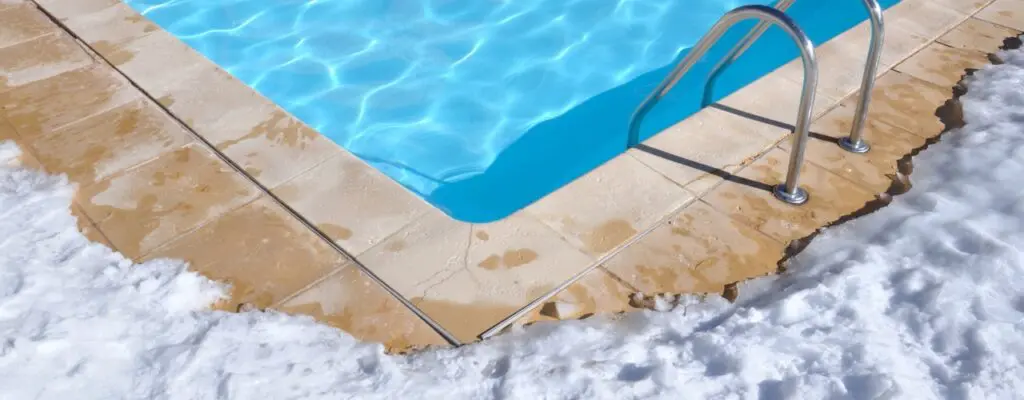
How to winterise your pool correctly

Winter Pool

When closing down your outdoor swimming pool for winter you need to create a sterile environment where microorganisms such as algae spores, fungi and bacteria cannot flourish. You also need to help prevent the formation of scale and staining from dissolved minerals so the water and pool surfaces are in good order when the pool is re-opened in spring.

If you can do this, you should hit the ground running at the start of next season as far as water quality is concerned, and avoid those expensive and time consuming clean-downs which are needed before the water begins to look acceptable again.

For Pools Run on Chlorine

First, shock dose the pool with an unstabilised granular chlorine. The high dose of chlorine will kill off any algae spores and bacteria that might be lurking in liner creases or in the surface of tile grouting. This will give you as near sterile water as possible. Now you need to keep it like this through the winter, as the chlorine will soon die away. You need to use a product that is specially formulated for overwintering and contains long life algicides and additives, which prevent the formation of scale and staining from dissolved minerals.

For Pools run on Bromine or Baquail

The above procedure and instructions opposite are aimed at pools run on chlorine, as it is by far the most commonly used outdoor pool sanitiser. There are parallel procedures for other disinfectants as follows.

Bromine is very similar to chlorine and can be shocked with shock dose. This should then be followed by the prescribed dose of winteriser product.

THE 14 STEPS YOU SHOULD FOLLOW IN ORDER TO WINTERISE YOUR POOL CORRECTLY

  1. Thoroughly backwash the filter. Remove any debris from the pump strainer, skimmers and pool water surface.
  2. Check the pH and adjust to 7.2 – 7.4.
  3. Shock dose with a stabiliser-free chlorine to kill any algae and harmful organisms that may be present. Allow the water to circulate for 3 – 4 hours to ensure thorough mixing.
  4. Close the valve/s from the skimmer/s and lower the water to 10cm – 15cm below the skimmer level. (It is important to heed any recommendations made by the pool installer and not lower the water level too much. This is especially important if there is a naturally high water table as this could present structural hazards to the pool shell).
  5. With the water still circulating through the bottom drain, add the winteriser product, pouring it evenly around the pool at the prescribed dose.
  6. Leave the circulation running for long enough to ensure thorough mixing.
  7. Remove ladders, diving boards and summer covers etc, and store them away from extremes of temperature.
  8. Switch off and isolate electricity supply. (If in doubt consult an electrician).
  9. Drain the water from the pump, heater and filter taking care to retain any ‘O’ rings from unions.
  10. Disconnect the pump and store in a frost-free, dry place away from extremes of temperature.
  11. Leave valves above water level open; those below should be closed and protected from frost damage.
  12. Some weighted and sealed polythene bottles can be used to absorb ice expansion. These should be floated along the length of the pool and secured with strong cord.
  13. Cover the pool with a heavy duty winter pool cover.
  14. Check the appearance of the water occasionally, along with the pH and free chlorine while the pool is shut down. If the winter is mild, add another dose of Winteriser in February and ensure thorough mixing and distribution throughout the pool.

How to open up your pool in spring

iStock-610013900 (1)

Getting your pool up and running for the new season is not too difficult, and the following guidelines should make life even easier for you. However, if you’ve got doubts that this particular line in DIY is not for you, give your local pool centre or service engineer a call.

For pools run on chlorine:

First, shock dose the pool with an unstabilised granular chlorine that gets to work the moment it is dissolved. The high dose of chlorine will kill off any algae spores and bacteria that might be lurking in liner creases or in the surface of tile grouting. This will give you as near sterile water as possible. Your pool water needs to be kept in good condition throughout the spring and summer, as the chlorine will soon dissipate.

You now need to add a chemical which special formulation contains a Long Life Algicide, Water Clarifier, and Anti Stain & Scale additives, which prevent the formation of scale and staining from dissolved minerals.

For pools run on bromine:

The above procedure and instructions opposite are aimed at pools run on chlorine, as it is by far the most commonly used outdoor pool sanitiser. There are parallel procedures for other disinfectants as follows. Bromine is very similar to chlorine and can be shock dosed with the same product. This should then be followed by a non-chlorine sanitiser, which is totally incompatible with chlorine and bromine.

The 13 Steps you should follow to open up your pool correctly:

  1. Remove surface water and debris from the winter cover before taking it off, then clean and dry it ready for storage.
  2. Using a leaf net, remove as much debris from the pool as possible and clean any tide marks at the water line using a cleaner chemical.
  3. Reconnect the pump if you removed it over winter making sure all electrical connections are free from dampness. Call in an electrician if you are in any doubt about what your are doing.
  4. Open any valves beneath the water line which may have been closed or plugged.
  5. Check there are no obstructions to the drains, the outlets and the pump strainer basket.
  6. If necessary, top up the water level so that it can be drawn in through the skimmer/s.
  7. Prime the pump, turn it on and check that the filter, skimmers and drains are all working. Do not be too concerned if the water from the circulation is discoloured initially. If the water level was too high because of rain over the winter, pump to waste.
  8. Run the filter for several hours, vacuuming out any remaining debris.
  9. Backwash the filter and top up with fresh water.
  10. Prepare the heat retention cover for use, cleaning off any patches of algae or mould.
  11. Check the pH and adjust to 7.2-7.4. Ask your dealer for pH reducer to lower the pH or pH increaser to raise the pH.
  12. Dose with shock product to kill any algae and harmful organisms that may be present. Allow the water to circulate for 3 to 4 hours to ensure thorough mixing.
  13. Then with the water still circulating, add algicide chemical, pouring it near the swimming pool inlet at the prescribed dose.

Why is a consistent and correct hot tub or pool water treatment regime important?

iStock-512543300

As we say, it is better to prevent than to cure. You need to keep your swimming pool or hot tub clean for a safe bathe.

For that, you would need to test your water at least 3 times a week. You will not only have a better control on your pool but you will also use less water treatment. 

Leaf Skimming

Leaf skimming removes debris before it sinks to the bottom of your pool. Debris becomes much more difficult to remove and can also cause staining if it reaches the bottom of the pool.

Use a long-handled leaf skimmer to remove leaves, insects, and any other debris floating on the pool surface.

Vacuuming

A weekly vacuuming is essential for keeping your pool consistently clean and maintaining sparkling clear pool water.

Vacuuming removes debris from the pool floor as particles that are left at the bottom of the pool can cause staining. If your vacuum attaches to the skimmer or to a designated vacuum point, be sure not to allow any air into the hose. In order to do this, submerge the vacuum head and hose underwater before connecting it.

Brushing

Regular brushing of pool walls and bottom prevents the unwanted build up of dirt, dust, leaves and dead insects. This debris can cause stains on your pool surface.

You should use a brush to remove loose dirt, dust and soil that has collected on the sides and bottom of your pool. Direct the collected dirt to the main drain so that it can be caught by recirculating currents or easily vacuumed. If your pool does not have a main drain, you should vacuum immediately after brushing. Concrete pools require a stiffer bristle than vinyl-lined pools.

Cleaning Tide Marks

Cleaning oily deposits along the water line (often due to the use of sun screen or body lotions) not only improves the appearance of the pool, but perhaps more importantly removes potential breeding sites for micro-organisms. 

Finally, you should change your sands in you swimming pool at least every 3 or 4 years.

Your chlorine or bromine should be around 2 ppm or 3 ppm and you should have a 7,2 ph. All this in order to have an optimum bathing comfort and sustainability of your pumps and heaters.

Why Use Stain and Scale Inhibitor?

iStock-522746284

In the Southeast England, we have very hard water. This water is full of calcium and products that are very aggressive for your hot tub or pool. Not doing anything firs up your hot tub and pool equipment like cattle.

Those products will help you preventing this situation from happening.

It is important to achieve the correct level of calcium in your water, the levels of which will vary depending on where you live and where your water supply comes from. Soft water tends to be low in calcium and hard water tends to be higher. Every time you top up or refill your hot tub with fresh water you need to check levels of calcium.

The ideal calcium hardness level for a hot tub is between 100 -200mg/l. If the level in your hot tub is below this it could lead to corrosion damage. If you do find the level is low, then use a suitable Cal hardener to bring it up to the correct level. If the level in your hot tub is above this it can lead to the water appearing cloudy. As a result, calcium can be deposited on the tub shell, heater element, filter cartridge element and the pipe work within. To reduce this use Hot Tub stain and scale inhibitor to stop stain and scale forming.

Hot Tub and Swim Spa Showroom – UK 2013 Showroom of The Year!

pool_spa_company_careers

The Multiple UK & European Award Winners

We would like to warmly invite you to join us to celebrate our brand new award… The highly prestigious 2013 Pool, Spa hot tubs and Wellness Showroom of The Year Award!

Nominated by industry experts and customers, we fought off the fierce competition and were awarded the gong by theinternational panel of Judges from 8 Countries!
We are pleased to be the first company in the UK to have:

  • An indoor sunken working Swim Spa
  • Electric pool safety cover with invisible panel
  • Outdoor Cedar barrel sauna in concrete shell
  • Unique Hydraulic gazebo with insulating properties
  • Largest showroom in the South East.

New Showroom also consists of:

  • The World’s Only Self Cleaning hot tubs.
  • The full range of Hydropool hot tubs, indoor traditional sauna, indoor
  • Infra Red sauna, bespoke tiled steam room, outdoor
  • Self cleaning swim spa, slatted insulated swimming
  • Pool cover, large Salt Water outdoor pool, Eco heating
  • Cleaning systems, water treatment, pool cleaners,
  • Wellbeing and Wellness Suite.